If you are selling a Georgetown townhouse, pricing is where the whole strategy begins. In a neighborhood with historic homes, block-by-block differences, and buyers who notice every detail, the wrong number can cost you time and leverage. The good news is that a disciplined pricing plan can help you attract serious interest, protect your negotiating position, and maximize your result. Let’s dive in.
Why pricing matters in Georgetown
Georgetown is an expensive market, but that does not mean any townhouse can command any price. In March 2026, the median sale price in Georgetown was $1,650,000, up 3.1% year over year, with 57 median days on market and 49 homes sold. Zillow also showed a median list price of $1,887,500 and 28 days to pending at the end of March 2026.
Those numbers are helpful for context, but they should not become your pricing formula. Different platforms measure different things, and Georgetown itself has meaningful micro-market variation. If you want the best pricing strategy, you need to anchor your list price to recent Georgetown townhouse sales in your immediate area, not broad metro averages or the highest active listing you can find.
Start with nearby sold comps
The safest way to price a Georgetown townhouse is to study the closest recent sold properties that truly compete with yours. That means comparing homes with similar location, condition, renovation level, parking, outdoor space, and overall utility. A townhouse on one block may perform very differently from a townhouse a few streets away.
Recent data supports that approach. Redfin reported a 98.8% sale-to-list ratio in Georgetown, and 20.4% of homes sold above list price. That tells you buyers will pay strong prices for the right property, but it also shows that most homes still close very close to asking, not wildly above it.
Why list prices can mislead
A nearby asking price can be tempting, especially if it is high. But list prices only show seller ambition, not buyer agreement. In Georgetown, where presentation and property specifics matter so much, an overpriced listing can sit, require reductions, and lose momentum.
That is why sold comps matter more than active comps. Sold properties show what buyers actually accepted in real time. For a seller, that is the most useful reality check.
Georgetown is a micro-market story
Not all of Georgetown moves the same way. One recent Redfin snapshot tied to East Village showed about 60 days on market and a $1.4 million median sale price. A West Village snapshot showed about 47 days on market and a $1.7 million median sale price.
That does not mean one area is always better than another. It means your pricing should reflect your specific micro-location and buyer pool. In Georgetown, block character, street appeal, and access patterns can all influence how buyers respond.
Price the block, not just the neighborhood
Neighborhood-wide averages can be too broad for a townhouse seller. A smarter strategy is to price from the block outward. Look first at the most recent sold homes that a buyer would genuinely compare to yours during a showing day or online search.
This is especially important when your property has a feature that is uncommon on your block, such as garage parking or a particularly usable rear patio. Those details may justify a premium, but only if the supporting comps are close and relevant.
The value drivers buyers notice most
Square footage matters, but it is not the whole story in Georgetown. Recent sales suggest that buyers often respond more strongly to renovation quality, parking, and outdoor usability than to size alone. When you set a list price, these features deserve real weight.
Renovation quality
A renovated Georgetown townhouse can command a very different response than a dated one. Buyers often price in the cost, time, and uncertainty of updates, especially in a historic district where some exterior work can be more constrained. If your home has updated systems, a newer kitchen, improved baths, or recent mechanical work, that can strengthen both pricing and marketability.
At the same time, sellers should avoid pricing a dated property like a fully renovated one. The 2026 sales examples show how quickly the market can separate those categories. Condition is not a minor detail here. It is one of the main drivers of buyer confidence.
Parking
Parking is a meaningful pricing variable in Georgetown. DC residential parking permit rules restrict on-street parking to designated blocks, and front-yard driveways are generally not permitted in rowhouse districts. New curb cuts or driveway changes also require approval.
That makes off-street parking, driveway access, or a garage harder to replicate than cosmetic upgrades. In practical terms, if your townhouse offers parking, that feature may influence value more than many sellers expect.
Outdoor space
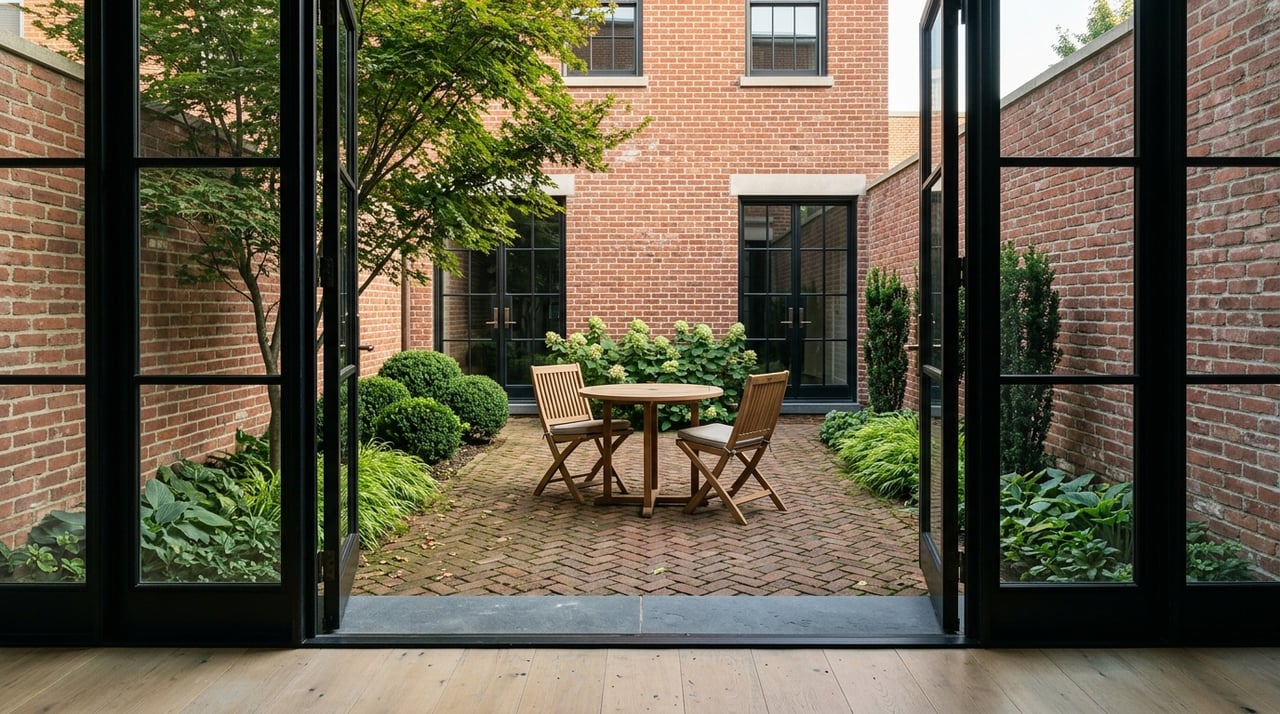
Outdoor living matters too. Recent Georgetown sales highlighted features like flagstone terraces, garden space, and private outdoor areas. In addition, local landscape guidance favors rear-yard patios and decks over highly visible front-yard alterations, which helps explain why usable rear outdoor space is often attractive to buyers.
If your townhouse has a private garden, terrace, or patio that feels functional and well maintained, it should be part of the pricing conversation. Buyers often see that kind of space as an extension of the home, not just a bonus.
Recent sales show the pricing spread
A few 2026 sales help illustrate how much outcomes can vary in Georgetown.
- 3255 O St NW sold for $3,300,000 on May 8, 2026 after being listed at $3,250,000. Redfin showed 0 days on market and a 2% over-list result. The home had been renovated in 2022 and was described as having substantial mechanical upgrades.
- 3127 O St NW sold for $2,119,000 on April 30, 2026 after starting at $2,495,000 and later reducing to $2,349,000 and then $2,250,000. It was renovated in 2014, had on-street parking, and included a garden terrace in East Village.
- 3011 Dumbarton St NW sold for $1,862,500 on February 18, 2026 after starting at $2,495,000 and later reducing to $1,999,000. It was renovated in 2017 and marketed with a flagstone terrace and garden.
- 3988 Georgetown Ct NW sold for $2,025,000 on March 31, 2026. This 3-bedroom, 3.5-bath, 2,072-square-foot Hillandale townhouse included a renovated kitchen, updated primary suite, renovated lower level, and a 2-car garage plus 2-car driveway.
The lesson is clear. Georgetown pricing is not driven by size alone, and the market does not reward optimism for its own sake. Features, condition, and location context can create a wide spread in results.
Avoid the overpricing trap
It is natural to want to leave room for negotiation. In Georgetown, that can make sense, but only in a measured way. Because some homes do sell above list price, a thoughtful pricing cushion may be reasonable in the right situation.
Still, the broader pattern suggests caution. With a sale-to-list ratio near asking overall, an aggressive premium can turn your listing stale instead of sparking competition. If the home does not clearly outperform nearby comps, too much pricing ambition can work against you.
What happens when a listing sits
When a townhouse sits on the market, buyers start asking why. They may assume the condition is weaker than expected, that the seller is unrealistic, or that a better opportunity may appear. Even if none of that is true, perception can soften demand.
Price reductions can help, but they rarely create the same energy as launching at the right number from day one. In a market like Georgetown, momentum matters.
Factor in historic district realities
Georgetown is not a typical townhouse market because it operates within a historic district with a separate review structure under the Old Georgetown Act. The DC Office of Planning notes that most exterior construction is reviewed by the US Commission of Fine Arts, and permit review procedures differ from nonhistoric parts of the city.
For sellers, that matters when considering pre-sale improvements. Exterior work, visible alterations, curb cuts, and driveway changes can be more constrained and more time-sensitive than you might expect. If you are planning updates before listing, it is smart to confirm review and permit implications early.
Improvements worth thinking through carefully
Before spending money, ask whether the improvement is legal, feasible, and likely to move buyer perception. In Georgetown, not every idea is equally practical. A well-prepared pricing and prep strategy should focus on what buyers value most and what can realistically be completed within local rules.
In many cases, the best move is not a major exterior change. It may be presenting existing strengths more effectively, refining interiors, and pricing the home to match the market honestly.
A smart pricing plan is part data, part positioning
The best pricing strategy is not just about choosing a number. It is about understanding how your home fits into Georgetown’s current market and how buyers will evaluate it against the competition. That means using recent sold data, identifying your townhouse’s strongest value drivers, and being realistic about any gaps versus renovated or better-positioned comps.
It also means thinking about launch strategy. A well-priced home that is thoughtfully prepared can create stronger early interest and better negotiating leverage than a home that starts high and chases the market later.
For Georgetown sellers, disciplined pricing is often the difference between testing the market and truly selling into it.
If you are preparing to sell a Georgetown townhouse, a tailored pricing strategy can make a meaningful difference in both timing and outcome. Hugh McDermott offers hands-on guidance with pricing, staging, negotiation, and closing coordination, backed by deep local market knowledge and a polished marketing approach.
FAQs
How should you price a Georgetown townhouse for sale?
- You should price it using the closest recent sold Georgetown comps in the same micro-area, with close attention to condition, parking, and outdoor space rather than relying on broad neighborhood averages or active list prices.
Does parking affect Georgetown townhouse value?
- Yes. In Georgetown, on-street parking rules, limited driveway options, and the difficulty of adding new parking access can make a garage or off-street parking a meaningful value factor.
Do patios and gardens help a Georgetown townhouse sell?
- Often, yes. Recent Georgetown sales featured terraces, gardens, and outdoor access, and usable rear outdoor space can be an attractive amenity for buyers.
Should you price a dated Georgetown townhouse like a renovated one?
- No. Recent sales show that renovation quality and updated features can materially change buyer response and sale outcome, even among homes in the same broader neighborhood.
Why do Georgetown townhouse prices vary so much?
- Prices can vary because Georgetown is highly sensitive to micro-location, renovation level, parking, outdoor usability, and how closely a home aligns with what buyers are comparing at that moment.