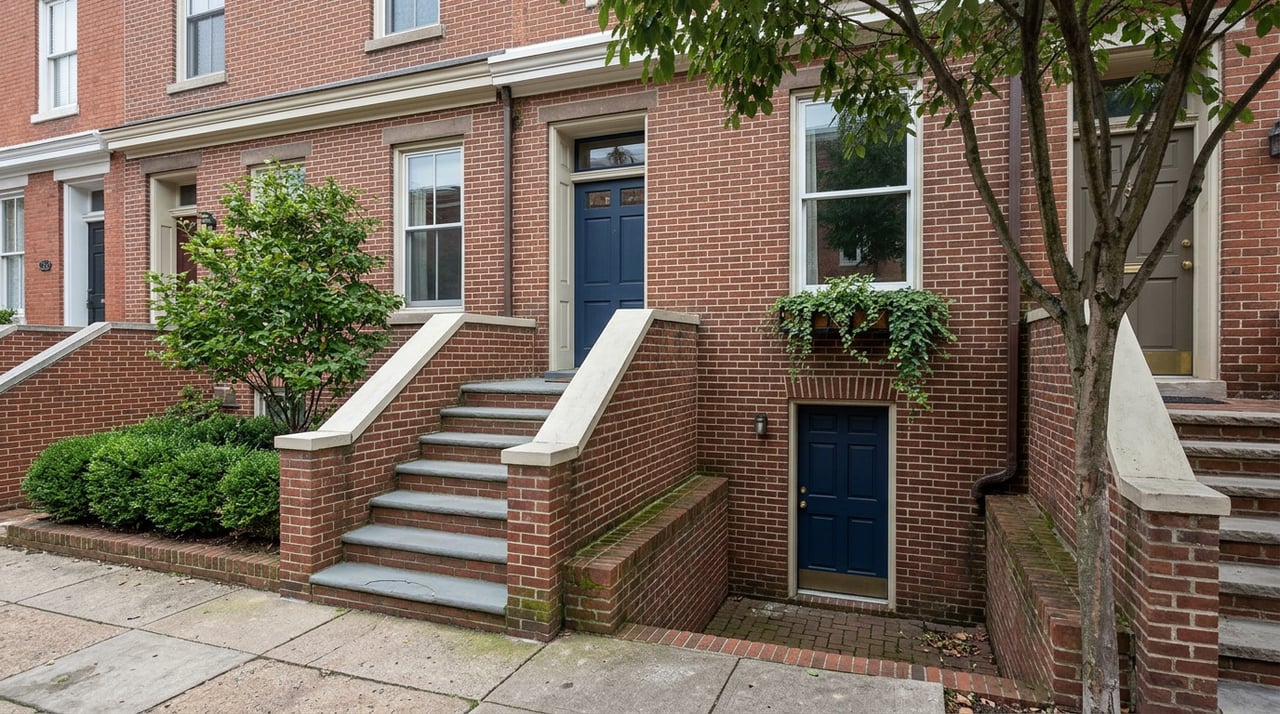
If your Georgetown rowhouse has an English basement you rent out, do you actually know whether it is exempt from the District's tenant purchase law? Most owners assume the answer is yes, because they remember hearing years ago that single-family homes got carved out of the rule. That memory is correct, but it is also incomplete, and the gap between "correct" and "complete" is where a listing can lose months.
The law in question is the Tenant Opportunity to Purchase Act, TOPA for short. When a rental property changes hands in DC, TOPA generally requires the owner to offer tenants the first chance to buy before selling to anyone else. Tenants can organize, negotiate, or assign that right to another buyer. Done properly, the process is a formality. Contested, it is not: a tenant association has 45 days to file a statement of interest, then 120 days to negotiate, then another 120 to 240 days to arrange financing depending on lender requirements. Add it up and a fully invoked TOPA process can run past a year. That is the number every Georgetown seller with a basement tenant needs in their head before they call a stager.
The exemption you think you have
Since July 2018, DC law has exempted single-family accommodations from TOPA, and the definition explicitly includes a house with an accessory dwelling unit such as a basement apartment or carriage house, as long as that unit is secondary to the main house in size and use and has its own kitchen and bath. For the vast majority of owner-occupied Georgetown rowhouses with a rented English basement, this exemption has applied for years. The only holdout: tenants who are 62 or older, or who have a disability, and signed their lease before March 31, 2018, who retain a narrow, limited right.
That is the version of the story most owners know. It is also the version that stops being reliable the moment your property does not fit neatly into one owner-occupied house with one small rental unit below it.
Where the assumption breaks
The single-family exemption depends on a classification, and classification is where Georgetown rowhouses get complicated. During the DC Council's own debate over this law, the Dupont Circle Advisory Neighborhood Commission raised a specific concern: in many rowhouse-dense neighborhoods, a house with a basement apartment is not always treated as a single-family home with an accessory unit. Under zoning definitions, it can instead read as a two-family accommodation, a different category entirely. The commission's point was not academic. It meant a seller could believe their basement rental fell under the 2018 exemption, only to find a title company or DHCD reviewer applying a different definition once an offer is on the table.
Georgetown's housing stock makes this more than a theoretical edge case. English basement units are one of the neighborhood's most common rental formats, found throughout its rowhouses in both the East Village and the West Village. A basement configured, permitted, or metered in a way that reads as a legally separate unit rather than a subordinate accessory space can push a property out of the exemption you were counting on.
What changed on December 31, 2025
The calculus shifted again with the Rebalancing Expectations for Neighbors, Tenants, and Landlords Act, known as the RENTAL Act. Mayor Bowser signed it on November 13, 2025, Congress let its review period lapse without action, and it took effect December 31, 2025. For owners of small multi-unit buildings, the most relevant piece is a new exemption for housing accommodations with two to four units, as long as the property is not owned in majority by a business corporation. If you own your rowhouse as an individual, through an LLC, or in a trust, this exemption likely applies to you even if your property was never a clean single-family case.
That is real relief for a lot of Georgetown owners. But the RENTAL Act did not remove paperwork, it relocated it. Even properties that qualify for the new exemption still have to send tenants a Notice of Transfer rather than a full Offer of Sale, and that notice starts a 45-day window in which a tenant can register an association to contest the exemption itself. Owners of properties newly exempt under the RENTAL Act also had to notify their existing tenants in writing of that exemption status by March 31, 2026, a deadline that has already passed but matters if you inherited a property or bought one this year without confirming that notice went out. New cooling-off periods apply too: tenants in 2-4 unit buildings that remain subject to TOPA cannot assign away their rights for 22 days after a valid offer of sale, and tenants in buildings with five or more units cannot do so for 45 days.
The stakes in plain terms
| Property situation | TOPA status after December 31, 2025 | What still has to happen before closing |
|---|---|---|
| Single-family rowhouse, owner-occupied, one basement rental | Exempt since 2018 | Notice to tenant within 3 days of an offer to sell |
| 2-4 unit building, owned by an individual, LLC, or trust | Newly exempt under the RENTAL Act | Notice of Transfer, plus a 45-day window for tenants to contest |
| 2-4 unit building, majority-owned by a business corporation | Still subject to TOPA | Full Offer of Sale process, 22-day cooling-off period before rights can be assigned |
| Rowhouse with an ambiguous basement unit (zoning reads it as two-family) | Depends on how the property is classified | Confirm classification before listing, not after an offer arrives |
The row that should catch a seller's attention is the last one. It is not rare in Georgetown, and it is the one where exempt or not exempt is a determination rather than a default.
What to do before you list, not after
The mistake sellers make is treating TOPA as paperwork to hand off to a settlement attorney once a buyer is under contract. By then, the classification question has already cost you the chance to fix it quietly.
- Confirm how your property is classified with your title company before you list, not during due diligence. Federal Title, a DC settlement company that has published detailed guidance on the RENTAL Act's rollout, notes that even legal practitioners are still working through unresolved questions as DHCD finalizes its regulations.
- Check your ownership structure. If your rowhouse is titled to a corporation rather than an individual, LLC, or trust, the new 2-4 unit exemption will not apply to you, and you should plan for a full process.
- If you have any tenant who is elderly or disabled and who signed their lease before March 31, 2018, treat that as its own conversation. Their rights survive every exemption discussed here.
- If a Notice of Transfer was owed to your tenant by the March 31, 2026 deadline and was never sent, resolve that before a buyer's attorney finds the gap.
- Build your listing timeline around the possibility that a contested TOPA process could add months, not days, and price that risk into how early you start.
A short FAQ
Does this apply to a Georgetown condo unit, not a rowhouse? A single rental unit inside a condo, co-op, or homeowners association building has its own exemption under the 2018 law, separate from the single-family and 2-4 unit categories described above.
What if I want to move my tenant out and occupy the basement myself before selling? That does not remove your TOPA obligations on its own. The classification and notice requirements attach to the property and its rental history, not just to who is living there on closing day.
Who actually decides whether my basement counts as an accessory unit or a separate unit? DHCD's Rental Conversion and Sale Division makes that determination when a dispute arises, which is exactly why confirming classification before you list, rather than after an offer, is the safer sequence.
Is this settled law now, or still changing? DHCD has up to two years from the RENTAL Act's effective date to finalize regulations interpreting it, and law firms including Ballard Spahr have noted they are still receiving informal guidance from the department in the interim. Treat anything you read on this topic, including this post, as accurate for today and worth reconfirming closer to your listing date.
None of this is a reason to delay a sale you are ready to make. It is a reason to have the classification conversation in month one instead of week two of a signed contract. If you own a Georgetown rowhouse with a rental unit and want a clear read on where your property stands before you list, Hugh McDermott can walk through the specifics with you and coordinate with a title company that already knows this law's current edges. Let's connect.