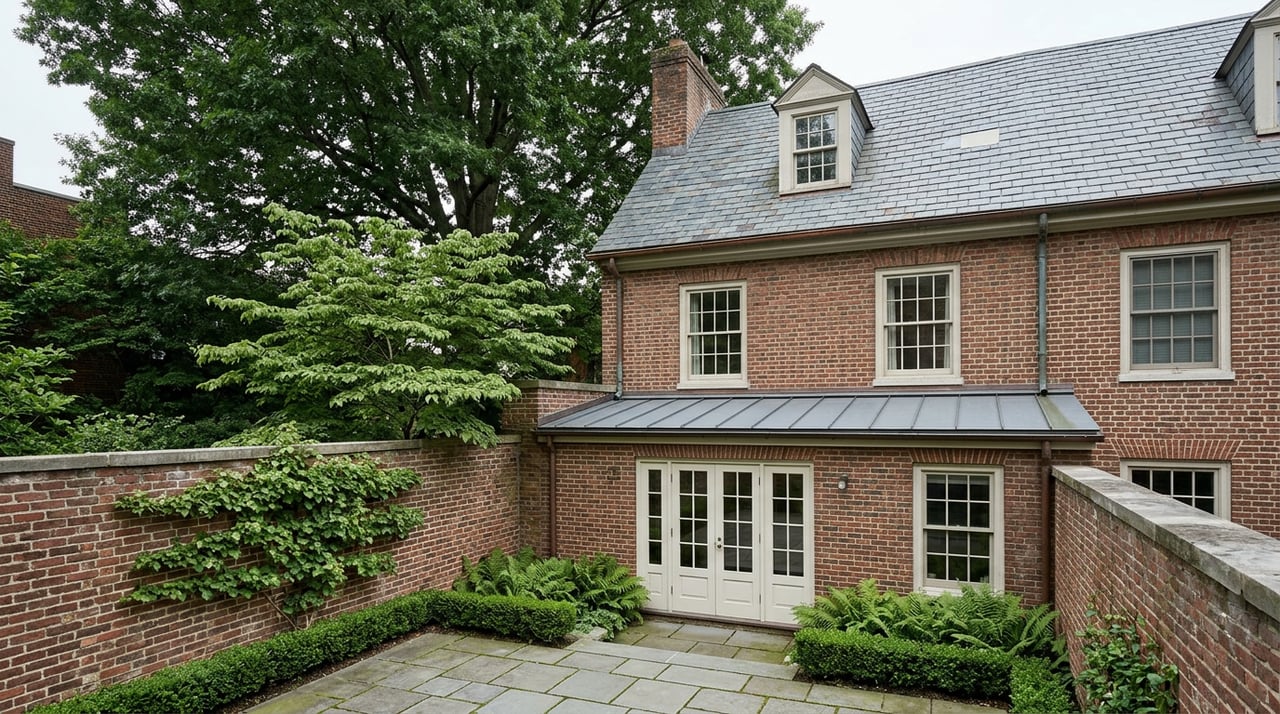
A seller I know in Georgetown wanted new windows before her listing photos went up. Not a gut renovation, just windows, the kind of job a contractor can usually turn around in a week once the units arrive. She budgeted three weeks and figured she'd have wiggle room.
She didn't. Because the moment those windows face the street, the decision about what she can install stops belonging to her, her contractor, or even her architect. It belongs to a three-person panel of architects called the Old Georgetown Board, and that panel meets once a month, on its own schedule, regardless of how close her photographer's appointment is.
That's the part about renovating in Georgetown that most guides skip past. Everyone knows the neighborhood is historic and that changes get reviewed. Fewer people understand that the review isn't a design conversation you can accelerate by being flexible or paying more. It's a calendar. And the calendar, not the contractor, is usually the actual constraint on a Georgetown renovation timeline.
The Board Moves Once a Month, Whether You're Ready or Not
The Old Georgetown Board is an advisory panel of three architects appointed by the U.S. Commission of Fine Arts to review exterior work in the historic district. It meets the first Thursday of most months, with the board's own FAQ noting the exceptions fall in January and August. Applicants present projects, the board makes recommendations, and those recommendations get bundled into what's called the Old Georgetown Appendix.
That appendix then goes to the full Commission of Fine Arts, which meets roughly two weeks later to take final action. A permit can't issue until that second meeting has approved the appendix. So even a completely uncontested project, the kind that sails through with no revisions requested, still needs to clear two separate meetings in two different weeks before a contractor can legally start.
Filing deadlines follow the same rigid pattern. The Commission's own submission requirements page lists a meeting on 7 May 2026 with a filing deadline of 16 April 2026, three weeks ahead. Miss that window and the case doesn't get pushed to next week. It waits for the next monthly cycle entirely.
Here's why that math matters more than it sounds like it should. As of June 30, 2026, Zillow's Home Value Index had Georgetown homes going to pending in around 14 days. That's a market moving fast. A seller who assumes her renovation will keep pace with her buyers is comparing two clocks that don't run at the same speed. The market can close a deal before the Board has even scheduled a first look at your project.
The One Question That Decides Whether Any of This Applies
The Commission's Old Georgetown FAQ draws a clean line: review is required for the exterior, and not required if the exterior isn't changing. A gutted kitchen, a reconfigured basement, new HVAC ductwork tucked inside walls, none of that needs Board sign-off, and it can move on the District's standard permitting timeline.
But the same FAQ includes a detail that trips people up. Site modifications, window and door replacements, mechanical equipment such as vents, meters, and rooftop condensers, and visible electrical wiring or lighting all require review, even when the homeowner thinks of the project as "interior." Swap a furnace and add a new roof vent, and you've triggered exterior review without touching a single wall someone can see from inside the house.
Rear-facing and alley-facing work counts too. A project doesn't get a pass just because it's not on the front elevation. That single distinction, visible versus not visible from public space, is the actual line item that determines whether your project needs five weeks of lead time or none at all.
What the Board Actually Signed Off on This Year
The Commission's public case records for 2026 show how far that review reaches, and how specific the conditions can get.
| Location | Project | 2026 Action |
|---|---|---|
| Rooftop, private residence | Solar array installation | Approved provided 15 individual panels were removed and several others reoriented from portrait to landscape |
| Right of way, M Street storefront | Streatery for Hershey's Ice Cream, four tables and seven chairs | Approved provided any plants in the planter stay alive |
| M Street storefront | Illuminated wall sign for Flavor Hive | Approved provided letters are no taller than 12 inches and mounted on a backboard |
| McNeir Auditorium, Georgetown University | Window restoration and alterations | Approved with conditions to salvage and store the original transom |
| 3036 O Street NW | Rear addition and fence replacement | Reviewed at the Board's April 2026 meeting |
| Alley lot | New two-story garage | Concept approved provided the overall height is reduced by at least 18 inches |
That Flavor Hive case is worth sitting with. The business that opened its brick-and-mortar storefront on M Street this fall had its sign dimensions decided by the Board back in June, months before a single customer walked in. The timeline between "we're opening" and "the sign can go up" runs through a monthly meeting cycle whether the business owner knew that going in or not.
The rooftop solar case makes a similar point in the other direction. Panel orientation on a roof nobody but a drone can see was still subject to review, down to which of more than a hundred individual panels stayed and which came out.
The Four-Year Clock Nobody Checks at the Walkthrough
If you're buying a Georgetown property with previously approved plans already on file, the approval has an expiration date, and it's easy to miss.
Concept approval from the Board expires after two years, though the FAQ allows for a one-year extension if requested before that window closes. Full permit approval expires after four years. If construction hasn't substantially started by then, the owner has to resubmit for a brand new review from scratch, meeting cycles and all.
That matters for a specific kind of buyer: someone touring a fixer-upper where the listing mentions "OGB-approved plans" as a selling point. Those plans are only worth what's left on the clock. A permit approved three years ago has roughly a year of runway. One approved five years ago is worthless as an approval, whatever the drawings still show. Before anyone factors approved plans into an offer, the actual approval date belongs in the due diligence file, not just the listing description.
What This Actually Means for a Listing or a Contract
For a seller, the practical move is to separate cosmetic staging, which doesn't touch the exterior, from anything that does. If new windows, a repainted door, or rooftop mechanical work are part of the pre-listing plan, the review clock needs to start the moment the scope is set, not after a contractor is already scheduled. Given the current pace of the market, with homes moving to pending in about two weeks as of this summer, a five-to-eight week approval runway can easily outlast the sale itself if it starts too late.
For a buyer evaluating renovation upside, the presence of prior Board approvals on a property is a real asset, but only with a date attached. Whether the seller has consulted the Board at all, and how recently, tells you something concrete about how much of that runway is actually still available to you after closing.
This is the layer of a Georgetown transaction that a walkthrough won't reveal and a listing sheet rarely spells out. It's also exactly the kind of detail worth working through with someone who tracks these cases as part of the neighborhood, not as an afterthought.
A Few Questions Worth Asking Before You Call a Contractor
Does repainting brick that's already painted require Board review? Painting previously unpainted masonry is treated as an exterior change subject to review. Repainting brick that's already painted is generally a maintenance item, though it's worth a quick confirmation with Commission staff before assuming.
What if the addition is on the back of the house, where no one from the street can see it? Rear-elevation and alley-facing work is still within the Board's scope. Visibility from a public street isn't the only trigger. Alleys count as public space too.
Can I speed up the process if I pay more or use a well-known architect? The monthly meeting cadence applies to every applicant. A strong, complete submission can avoid a second round of revisions, which saves a full cycle, but it doesn't move the calendar itself.
Is there any way to know before I close whether a property's approved plans are still valid? Yes. The approval date is part of the public record with the Commission, and it's a reasonable ask before finalizing a purchase involving inherited plans.
If you're weighing a Georgetown renovation against a listing date, or trying to figure out how much runway is left on a fixer-upper's existing approvals, Hugh McDermott can walk through the timeline with you before it becomes a surprise. Let's connect.